President Barack Obama has invoked his distress at the death of his grandmother to combat suggestions that his health care reforms would create "death panels" for the elderly.
The president's grandmother, Madelyn Dunham, died on election day last year after a long battle with cancer. Mr Obama discussed his anguish at her death and rejected allegations that his plans would deny care to elderly patients.
"I just lost my grandmother last year. I know what it's like to watch somebody you love who's ageing deteriorate, and have to struggle with that," Mr Obama said. "So the notion that somehow I ran for public office or members of Congress are in this so they can go around pulling the plug on grandma? I mean, when you start making arguments like that, that's simply dishonest."
The American airwaves have been inundated with claim and counter claim about the health care plans. Supporters of Mr Obama's reforms have outspent their opponents $24 million (£14.5 million) to $9 million, with the overall total being largest sum spent on a single issue campaign.
Public reservations are deep-rooted even though 47 million Americans have no health insurance.
The president's stepmother, Kezia Obama, has entered the fray by claiming that the NHS saved her life when she suffered chronic kidney failure. US media gave prominent coverage to reports that Mrs Obama fell seriously ill with kidney failure and pancreatic problems during a summer visit to Britain seven years ago. The 66-year-old, who now lives in Bracknell, Berkshire, said she could not have afforded treatment in America.
"It's very simple: I owe my life to the NHS," she said. "If it wasn't for the NHS I wouldn't have been alive to see our family's greatest moment - when Barack became president and was sworn into the White House."
Her intervention came after Republicans branded the NHS "evil" and "Orwellian".
At his town hall meetings Mr Obama introduced members of the audience who had been denied health care by insurance companies, a practice which will be banned under his reforms. "If you think that can't happen to you or your family, think again," he said.
In an article in the New York Times, he said he was confident that his drive to overhaul the US health care system would succeed. Reform was closer to reality "than we have ever been", he said, citing support from the American Nurses Association, the American Medical Association and the American Association of Retired People.
He also said there was "about 80 per cent" agreement in Congress on the shape of the reform plan that he expected to emerge as legislation.
A vigorous debate about health care was, he said, "what America's all about". But he gave warning that "in the coming weeks, the cynics and the naysayers will continue to exploit fear and concerns for political gain.
"What's truly scary, truly risky is the prospect of doing nothing. If we maintain the status quo, we will continue to see 14,000 Americans lose their health insurance every day. Premiums will continue to skyrocket. Our deficit will continue to grow. And insurance companies will continue to profit by discriminating against sick people."
Source

When President Barack Obama unveiled a $12 billion plan to help community colleges prepare millions of people for a new generation of jobs earlier this week, it recognized the growing role of community colleges across the nation, state and local officials said.
Obama announced the initiative on Tuesday in a state reeling from the loss of auto jobs. Michigan’s unemployment rate is 14.1 percent, the nation’s worst.
“The hard truth is that some of the jobs that have been lost in the auto industry and elsewhere won’t be coming back,” Obama told a crowd at Macomb Community College in Warren, Mich. “They are the casualties of a changing economy.”
To that end, he proposed an “American Graduation Initiative” to bolster the two-year community college field that serves millions of students as a launching point for careers or a step toward expanded higher education. The idea is to train people for jobs, such as those expected in the clean energy industry, when the economy turns around and begins to create jobs again instead of shedding them.
Under the plan, competitive grants would be offered to schools to try new programs or expand training and counseling.
High dropout rates would be addressed by designing programs to track students and help them earn an associate’s degree or finish their education at a four-year institution. Money would also be spent to renovate and rebuild facilities, and online courses would be developed to help colleges offer more classes.
The White House says the cost would be $12 billion over 10 years; Obama says it would be paid for by ending wasteful subsidies to banks and private lenders of student loans.
“Time and again, when we have placed our bet for the future on education, we have prospered as a result,” Obama said.
Louisiana Delta Community College Chancellor Luke Robins said Obama’s announcement was a realization of the importance of community colleges.
“It’s a very positive response and it will be interesting to see how the Congress moves forward with it,” Robins said.
“I don’t see it as a long-term fix for declining state funding for higher ed. What it gives the LCTCS (Louisiana Community and Technical College System) is some seed money to start programs aimed at improving graduation and retention rates. We’re a developing system, and those kinds of programs take some money to get off the ground.”
LCTCS President Joe May is also pleased with Obama’s proposal.
“President Obama’s announcement really speaks to an understanding of the critical role of community and technical colleges in providing solutions toward developing a competitive workforce for our country and specifically the State of Louisiana,” May said.
“This tremendous investment in the areas of facilities, online courses, and program development and expansion can greatly assist our colleges in facilitating economic recovery for our state and increasing the skills level attainment of our local citizenry. Therefore, this announcement couldn’t be more timely as we continue to focus on transforming Louisiana’s work force and developing the high demand, industry-sensitive training needed for jobs of the 21st century.”
Republican Sen. Lamar Alexander of Tennessee, a former education secretary, said Obama’s plan is a “typical proposal” that sounds better than it is. “When our biggest problem as a country is too much debt, he’s taking the entitlement spending he claims to be saving from the student loan program and adding it to the debt,” Alexander said.
Source
Saying that civil rights leaders from decades past paved the way for his election as the nation's first black commander in chief, President Barack Obama paid homage to the NAACP and advised members that their work remains unfinished.
Obama traced his historic rise to power to the vigor and valor of black civil rights leaders, telling the nation's oldest civil rights organization Thursday night that their sacrifice "began the journey that has led me here." He also prodded them to look beyond simply African-American rights as the group celebrated its 100th convention.
"Make no mistake: The pain of discrimination is still felt in America," the president told the friendly audience that erupted in standing applause and the occasional "Amen" during his remarks.
Rousing his audience, Obama offered his most direct speech on race since winning the White House, a mix of personal reflection and policy promotion. He had worked on the address for about two weeks and revised it until shortly before he spoke, his aides said, underscoring the importance of his message and his audience.
Implicit in his appearance was that he is seeking the backing of the powerful NAACP and its members for his ambitious domestic agenda. He also is careful not to forget a groundswell of black voters who reshaped the electoral map, although they didn't singularly deliver him to the White House.
Painting himself as the beneficiary of the National Association for the Advancement of Colored People's work, Obama cited historical figures from W.E.B. DuBois to Thurgood Marshall, Martin Luther King Jr. to Emmet Till to explain how the path to the presidency was cleared by visionaries.
Despite the racial progress exemplified by his own election, Obama said African-Americans must overcome a disproportionate share of struggles, including being more likely to suffer from many diseases and having a higher proportion of children end up in jail.
"They're very different from the barriers faced by earlier generations. They're very different from the ones faced when fire hoses and dogs were being turned on young marchers," Obama said. "But what's required to overcome today's barriers is the same as what was needed then. The same commitment. The same sense of urgency."
Obama expanded his message of equal rights beyond the black communities. He said many Americans still face discrimination and suggested the NAACP — looking to declare a mission for its second century — might embrace a broader mandate in coming years.
Obama's remarks, steeped in his personal biography as the son of a white mother from Kansas and black father from Kenya, challenged the audience — those in the room and those beyond — to take greater responsibility for their own future.
He urged parents to take a more active role, residents to pay better attention to their schools and students to aspire beyond basketball stars and rappers.
"I want them aspiring to be scientists and engineers, doctors and teachers, not just ballers and rappers," Obama said. "I want them aspiring to be a Supreme Court justice. I want them aspiring to be president of the United States."
With that line, Obama drove the hotel ballroom audience to its feet.
Throughout his comments, Obama sought a balance, contending that the government must foster equality but individuals must take charge of their own lives. It was reminiscent of earlier Obama speeches, calling on fathers to help their children and adopting a tone that at times seemed drawn from the pulpit.
"We have to say to our children, `Yes, if you're African-American, the odds of growing up amid crime and gangs are higher. Yes, if you live in a poor neighborhood, you will face challenges that somebody in a wealthy suburb does not have to face," Obama said, returning to his tough-love message familiar from his two-year presidential campaign.
"But that's not a reason to get bad grades, that's not a reason to cut class, that's not a reason to give up on your education and drop out of school. No one has written your destiny for you. Your destiny is in your hands."
Today, Obama said, it is not prejudice or discrimination that presents the greatest obstacles for blacks, but rather structural inequities_ in areas such as education and health care. Still, he said discrimination persists — and not just for blacks — and chided those who may contend otherwise.
Source
President Obama hits Big Tobacco hard with Family Smoking Prevention and Tobacco Control Act

Read more: http://www.nydailynews.com/news/politics/2009/06/23/2009-06-23_bam_inks_law_thats_pain_in_ash_for_big_tobacco.html#ixzz0JFbanDRk&C
With a nod to his own struggle with nicotine addiction, President Obama signed a bill Monday giving federal regulators sweeping new powers to scare smokers straight.
"Almost 90% of all smokers began at or before their 18th birthday. I know I was one of these teenagers, and so I know how difficult it can be to break this habit when it's been with you for a long time," said Obama.
Obama gave up cigarettes three years ago at wife Michelle's insistence, but he and White House aides have been cagey about whether he still chews nicotine gum or sneaks the occasional smoke.
The law empowers the Food and Drug Administration to crack down on Big Tobacco's efforts to lure kids into lighting up.
Later this year, the law will take cigarettes with candy, fruit and spice flavors off the shelves for good.
By next spring, tobacco manufacturers will no longer be allowed to sponsor sports and entertainment events under their brand names, nor will they be allowed to sell or give away logo clothing or other items. Distributing free samples of cigarettes and smokeless tobacco will be allowed only in adult-only facilities.
And in 2011, the FDA will be able to order manufacturers to place chilling, stark warning labels on half of the front or half of the back of a pack of cigarettes on the deadly and disabling diseases caused by smoking.
"There is plenty of evidence that graphic warnings in other countries send a message to kids that smoking is not cool," said Matt Myers, president of the Campaign for Tobacco-Free Kids. "These pictures can tell of the effects of smoking better than any words ever could."
Tobacco companies fought against such controls for 15 years.
"Their campaign has finally failed," Obama said. "[The law] will force these companies to more clearly and publicly acknowledge the harmful and deadly effects of the products they sell."
Earlier this year, Obama signed a bill increasing the federal cigarette tax from 39 cents to $1.01 a pack, pushing the typical cost in New York City over $10.
Nearly 20% of Americans are smokers. The use of tobacco products kills about 440,000 people a year in the U.S.
Source
Obama to ask doctors to back his health care plans
President Barack Obama, continuing to barnstorm for his health care proposals, will urge doctors gathered in Chicago to support wider insurance coverage and targeted federal spending cuts.
Obama planned to tell the American Medical Association's annual meeting in his hometown on Monday that overhaul cannot wait and that bringing down costs is the most important thing he can do to ensure the country's long-term fiscal health, a senior administration official said.
The official spoke on the condition of anonymity to discuss the president's remarks before they were delivered.
The nation's doctors, like many other groups, are divided over the president's proposals to reshape the health care delivery system. The White House anticipates heavy spending to cover the almost 50 million Americans who lack health insurance and has taken steps in recent days to outline just where that money could be found.
For instance, Obama wants to cut federal payments to hospitals by about $200 billion and cut $313 billion from Medicare and Medicaid. He also is proposing a $635 billion "down payment" in tax increases and spending cuts in the health care system.
To an audience of doctors Obama plans to say the United States spends too much on health care and gets too little in return. He says the health industry is crushing businesses and families and is leading to millions of Americans losing coverage, the administration official said.
Obama's turn before the 250,000-physician group in his latest effort to persuade skeptics that his goal to provide health care to all Americans is worth the $1 trillion price tag it is expected to run during its first decade.
The president plans to acknowledge the costs. But he also will tell the doctors it is not acceptable for the nation to leave so many without insurance, the official said.
Unified Republicans and some fiscally conservative Democrats on Capitol Hill have said they are nervous about how the administration plans to pay for Obama's ideas.
The New York Times reported Monday that Obama has been quietly making a case for reducing malpractice lawsuits to help control costs, long a goal of the AMA and Republicans. Obama has not endorsed capping jury awards
Obama has been speaking privately with lawmakers about his ideas and publicly with audiences, such as a town hall style meeting last week in Green Bay, Wis. Obama and his administration officials have blanketed the nation in support of his broad ideas, and Vice President Joe Biden on Sunday said it's up to Congress to pin down the details on how to pay for them.
"They're either going to have to agree with us, come up with an alternative or we're not going to have health care," Biden told NBC's "Meet the Press."
"And we're going to get health care."
In Chicago, the president's remarks are likely to focus on how his ideas might affect the medical profession.
His proposed cuts in federal payments would hit hospitals more directly than doctors, but physicians will be affected by virtually every change that Congress eventually agrees to. Many medical professionals are not yet convinced Obama's overhaul is the best for their care or their pocketbooks.
Broadly, the AMA supports a health care "reform" — a term that changes its definition based on who is speaking — although the specifics remain unclear.
In a statement welcoming Obama, AMA president Dr. Nancy Nielsen said the medical profession wants to "reduce unnecessary costs by focusing on quality improvements, such as developing best practices for care and improving medication reconciliation."
She also said doctors need greater protection from malpractice lawsuits and antitrust restrictions.
Many congressional Republicans, insurance groups and others oppose Obama's bid for a government-run health insurance program that would compete with private companies. On Sunday, Senate Minority Leader Mitch McConnell, R-Ky., described a government plan as a "nonstarter."
"There are a whole lot of other things we can agree to do on a bipartisan basis that will dramatically improve our system," he said.
To that end, lawmakers were considering a possible compromise that involved a cooperative program that would enjoy taxpayer support without direct governmental control. The concessions could be the smoothest way to deliver the bipartisan health care legislation the administration seeks by its self-imposed August deadline, officials said.
"There is no one-size-fits-all idea," Health and Human Services Secretary Kathleen Sebelius told CNN's "State of the Union" on Sunday.
"The president has said, 'These are the kinds of goals I'm after: lowering costs, covering all Americans, higher-quality care.' And around those goals, there are lots of ways to get there."
Momentum might be on Obama's side. Aaron Carroll, an Indiana University medical professor who has surveyed doctors' views on U.S. health care delivery, said 59 percent "favor government legislation to establish national health insurance," an increase over a previous poll's finding.
He noted that many doctors are not AMA members, and therefore the association's views should not be overrated.
Source
Obama rebukes Bush's democracy-building effort
President Barack Obama says no country should try to impose a system of government on another nation.
It was a direct rebuke to efforts by his predecessor — George W. Bush — to spread democracy worldwide. And, it signaled to Muslim nations that Obama's administration won't follow suit.
Obama says America doesn't presume to know what is best for everyone. And, he says the U.S. doesn't presume to pick the outcome of a peaceful election.
But Obama also says he believes governments must reflect the will of their people. And, he says he believes all people want to be able to speak their minds and have a say in how they are governed. He says he believes people want to have confidence in law and justice, as well as a transparent government and the freedom to live as they choose.
Source
World leaders: We can unite to defeat economic crisis
Leaders attending the G-20 summit in London Thursday said they were confident they could bridge their differences to unite on a plan to help address the economic crisis.
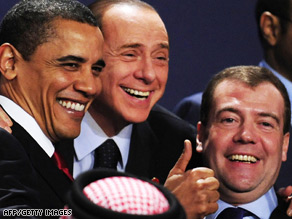
Barack Obama, Silvio Berlusconi and Dmitry Medvedev share a laugh at the G-20 summit.
There had been concerns that a rift was opening up between the approach being championed by the U.S. and Britain and that favored by France and Germany.
The U.S. and Britain want countries to agree to more economic stimulus ahead of new rules for the banking system.
France and Germany want the rules first -- and tougher ones than initially suggested -- and remain resistant to pumping more money into their economies.
However, European Commission President Jose Manuel Barroso said he was confident about the result of the summit.
"There is a great degree of convergence," he told CNN Thursday morning.
British Business Secretary Peter Mandelson was less upbeat, telling CNN there were some "strains" among the delegates.
"I hope very much that they will be ironed out and we'll come out with agreement at the end of the day." Video Watch more on the G-20 summit »
The leaders say they want to find ways to stabilize financial markets throughout the world and pull the world out of a deepening recession.
They sat at the table Thursday for their first session with several targets in their sights, including tax havens and protectionism.
French Finance Minister Christine Lagarde called for a firm stand on tax havens.
Fact Box
This week's London Summit brings together the leaders of the world's 20 largest economic powers, known as the Group of 20, to discuss the global financial crisis and decide new measures to set the world on a more stable economic footing.
Barroso backed her up.
"We have to be clear that those that want to keep shadow banking systems that are kind of underground (with) clandestine finances have to suffer sanctions, because it's once again a problem of confidence," Barroso said.
"We are for open economies and open markets, but open economies and open markets have to respect some rules." Video Watch European Commission chief on summit »
Britain will push for the same regulation of banks and financial institutions that operate in a "shadow banking world," Mandelson said. He said an international body should oversee the regulation.
Leaders will also be pushing for more fiscal stimulus.
British Prime Minister Gordon Brown is arguing for world leaders to maintain their investments and fiscal stimuli while also giving more money to institutions like the International Monetary Fund, Mandelson said.
The IMF can then deliver those resources to poorer countries and emerging economies, he said. Video Watch more on the protests »
"They are becoming major drivers of growth in the global economy," Mandelson said of those countries. "So we want a strong commitment, a hefty infusion of resources." Video Watch more on the first wives' club »
Brown wants success on five points: restoring growth to emerging market economies; a "clean up" of the global banking system; commitment to encourage growth and help the poor; protectionism rejected and a push for investment in the environment.
Barroso and Mandelson called for concrete commitments on the economy.
Earlier this week French President Nicolas Sarkozy said that if the summit's final communique failed to contain strong language and clear steps, he may even walk out of the meeting.
He and German Chancellor Angela Merkel said Wednesday they could accept debate and negotiation as long as firm steps were taken.
advertisement
There were only a few protesters outside the summit when it started Thursday -- a marked difference from the thousands who gathered in central London 24 hours earlier.
Lifting the stem-cell research ban is only the first step
On Monday, I was honored to be present at the White House ceremony as President Barack Obama lifted the ban on federal funding for embryonic stem-cell research. His long-awaited executive order marks a critical milepost in the race to develop biologic cures. Indeed, it comes just weeks after American scientists announced a huge stem-cell breakthrough.
Using stem-cell lines, researchers developed a therapy that reverses some symptoms of multiple sclerosis. The results were all the more remarkable given that none of the patients in the study had responded to standard treatments. Essentially, doctors used stem-cell transplants to ''reset'' patients' immune systems. The technique also shows promise in combating lupus and diabetes.
This breakthrough highlights the importance of President Obama's decision. Lifting the ban will expand the development of similar biomedical advances that may lead to treatments and possibly even cures for devastating diseases such as cancer, AIDS and Parkinson's.
The biotechnology community strongly supports Obama's action to remove the ban. But this is just a first step toward moving from the promise of research to therapies and cures for patients. Public funding only supports the initial stages of research. According to Stanford medical professor Phyllis Gardner, less than 2 percent of biotechnology funding comes from government sources. It is private capital that finances the ''transitional'' research needed to turn in-lab advances into usable medicines.
The biotechnology industry spends an enormous amount on research and development. In 2005, companies spent $20 billion on R&D with the bulk of the funds coming from private investors. These funds finance critical steps in moving from basic research to final therapies and treatments, which include rigorous FDA review and testing in addition to several rounds of clinical trials. Even after the original research has been completed, it can take 10 to 12 more years and over $1 billion in investment to bring a new therapy successfully to patients.
Many firms go years before making money. Nektar Therapeutics, for instance, was in the red for the first 14 years of its existence despite raising more than $1.2 billion in funding and having several products on the market. Today, Nektar is developing promising treatments for cancer, HIV and many other ailments.
That's why the president and Congress must protect incentives for private investment into stem-cell research and the continued development of cures and therapies. Doing so requires that they pursue public policies that balance the need to increase access to today's medicines with the need to develop tomorrow's cures.
One early test will come as Congress considers reforming our nation's patent laws. The recently introduced Patent Reform Act would weaken intellectual property rights by softening penalties for those who violate them. If patent laws are watered down, investors will redirect their money toward industry sectors that provide more certainty and a faster rate of return, creating a chilling effect on scientific innovation and the race to find cures for unmet medical needs.
Meanwhile, the push for price controls on biotech treatments is no less dangerous than the campaign against patents. Specifically, Obama has proposed requiring biotechnology and pharmaceutical companies to give bigger discounts, or rebates, to Medicaid, the health program for low-income people.
Source
Looks like Michelle Obama isn't the only one with an eye on fashion.
Barack Obama is shaking things up by challenging the supremacy of the business suit in the one town in America where a suit still equals power. According to several reports, casual Friday style is becoming everyday style in the Obama White House, with the president encouraging staffers to take off their jackets, even in the Oval Office. (Lord knows they have enough work to do; they need to get comfortable and roll up their sleeves, even though that won't do much to help suit sales.)
In an interview with Matt Lauer on "Today," Obama broke with the suit-and-tie uniform again and wore a casual button-down shirt sans tie. It was a Sunday afternoon and Obama was hanging at home before the Super Bowl, but it was yet another indicator of the dawn of a more relaxed Washington wardrobe.
Besides reflecting Obama's easygoing nature, the casual approach to dressing sets him apart visually from the corrupt "suits," the CEOs and Wall Street opportunists that he's trying to bring down to earth.
Do you think Obama's casual style is appropriate for the White House?
Source

Obama's First Day: War, Ethics, Recession, Guantanamo, Mideast (VIDEO, TRANSCRIPT)
On Obama's first day in office, Republicans expressed resistance to the Democratic stimulus plan,
Facing Republican resistance to a massive economic stimulus plan, the Obama administration on Wednesday said $3 of every $4 in the package should be spent within 18 months to have maximum impact on jobs and taxpayers...
Indeed Republicans, who said they were receptive to Obama's call for a "unity of purpose," promptly tested the day-old administration. They criticized the Democratic plan and requested a meeting with the president to air their tax-cutting plans.
The New York Times reports that Obama is expected to sign executive orders closing the CIA's network of secret prisons and the closing of Guantanamo on Thursday:
President Obama is expected to sign executive orders Thursday directing the Central Intelligence Agency to shut what remains of its network of secret prisons and ordering the closing of the Guantanamo detention camp within a year, government officials said...
And the orders would bring to an end a Central Intelligence Agency program that kept terrorism suspects in secret custody for months or years, a practice that has brought fierce criticism from foreign governments and human rights activists. They will also prohibit the C.I.A. from using coercive interrogation methods, requiring the agency to follow the same rules used by the military in interrogating terrorism suspects, government officials said.
In addition, the Obama administration declared their willingness to talk to Iran "without preconditions," as reported by The Guardian.
The Obama foreign policy agenda that appeared on the White House website declared: "Barack Obama supports tough and direct diplomacy with Iran without preconditions." The Bush administration made direct talks between the US and Iran conditional on Iranian suspension of its uranium enrichment programme. The only exception was some discussion in Baghdad on the future of Iraq.
The Obama initiative represents a distinct break from that policy, as part of a fundamental shift in diplomatic approach. The Obama agenda said the new administration would "talk to our foes and friends" and not set preconditions.
From AP: President Barack Obama's first public act in office Wednesday was to institute new limits on lobbyists in his White House and to freeze the salaries of high-paid aides, in a nod to the country's economic turmoil.
Announcing the moves while attending a ceremony in the Eisenhower Executive Office Building to swear in his staff, Obama said the steps "represent a clean break from business as usual."
In addition to staff and ethics orders, President Obama's schedule was filled with meetings about the war in Iraq, the recession, phone calls with world leaders among other initiatives. His administration also kept an eye on various cabinet nominations moving through the Senate, including Hillary Clinton's recently confirmed position as Secretary of State.
More on the White House pay freeze:
The pay freeze, first reported by The Associated Press, would hold salaries at their current levels for the roughly 100 White House employees who make over $100,000 a year. "Families are tightening their belts, and so should Washington," said the new president, taking office amid startlingly bad economic times that many fear will grow worse.
Those affected by the freeze include the high-profile jobs of White House chief of staff, national security adviser and press secretary. Other aides who work in relative anonymity also would fit into that cap if Obama follows a structure similar to the one George W. Bush set up.
Obama's new lobbying rules will not only ban aides from trying to influence the administration when they leave his staff. Those already hired will be banned from working on matters they have previously lobbied on, or to approach agencies that they once targeted.
The rules also ban lobbyists from giving gifts of any size to any member of his administration. It wasn't immediately clear whether the ban would include the traditional "previous relationships" clause, allowing gifts from friends or associates with which an employee comes in with strong ties.
The new rules also require that anyone who leaves his administration is not allowed to try to influence former friends and colleagues for at least two years. Obama is requiring all staff to attend to an ethics briefing like one he said he attended last week. read more

President-elect Barack Obama speaks at inaugural concert
watch performances from the concert
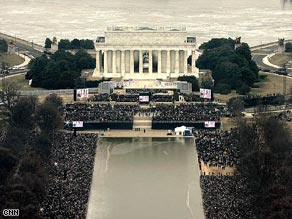
Thousands gather Sunday afternoon on the National Mall in Washington.
Inauguration revelry began Sunday afternoon as thousands of people packed the National Mall in Washington for a free concert featuring big stars.
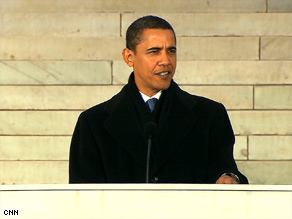
President-elect Barack Obama addressed a roaring crowd after 90 minutes of high-energy acts such as U2, Mary J. Blige, Usher and Beyonce.
"Welcome to this celebration of American renewal," he said.
"In the course of our history, only a handful of generations have been asked to confront challenges as serious as the ones we face right now."
"I stand here today as hopeful as ever that the United States of America will endure," Obama said. "That it will prevail; that the dream of our founders will live on in our time."
Obama spent the morning visiting Arlington National Cemetery and attending church before heading to the "We are One: Opening Inaugural Celebration" at the Lincoln Memorial. It was nothing but good vibes -- a brief respite for an incoming president who will face huge problems after he takes office Tuesday.
Bruce Springsteen opened the concert with his song "The Rising," singing, "How far I've gone/How high I've climbed/On my back's a 60 pound stone/On my shoulder a half mile line."
Along the National Mall, between the Capitol and the Washington Monument, people watched the concert on massive screens and sang along with "America the Beautiful" and "This Land is Your Land."
During U2's performance of "Pride (In the Name of Love)," a tribute to the Rev. Martin Luther King Jr., frontman Bono referenced the civil rights leader's "I Have a Dream" speech, saying that it was also, "an Irish dream, a European dream, and African dream, an Israeli dream, and a Palestinian dream." read more
Cuba: Caribbean Nations Urge Obama to End Embargo
Caribbean countries urged President-elect Barack Obama on Monday to end the American trade embargo on Cuba. Mr. Obama has pledged to ease restrictions on Cuban-Americans traveling to Cuba and sending money there, but has said he wants to maintain the embargo to press for changes in the Communist-run country. “The Caribbean community hopes that the transformational change that is under way in the United Status finally relegates that measure to history,” said Prime Minister W. Baldwin Spencer of Antigua and Barbuda, chairman of the Caricom group of Caribbean nations, which was meeting in Santiago de Cuba.
Source
When President-elect Barack Obama announced his foreign policy team on Dec. 1, he listed four "American values" that his government will pursue: "Democracy and justice; opportunity and unyielding hope -- because American values are America's greatest export to the world."
All that was part of Obama's campaign promise to restore American moral standing abroad. Right now, it's still just words. It's time to ask what kind of nuts and bolts policies actually would put those values into action.
Clearly, as Obama reiterated after the election, the first step must be to undo the long list of abuses that have tarnished our national honor -- aggressive war, Guantanamo, officially sanctioned torture and so on. But that's just playing defense, trying to remedy our past wrongs and lessen our sense of shame.
Obama is promising to go further -- to export opportunity and hope as well. And that is why, as president, Obama will have good reason to look at U.S. refugee policy and to make it a centerpiece of his international agenda.
In European elections, rising xenophobia leads politicians to compete to show their hostility to asylum seekers. But Americans are supposed to be different. As Obama told Europeans in Berlin in July, "Our allegiance has never been to any particular tribe or kingdom -- indeed, every language is spoken in our country; every culture has left its imprint on ours." read more
Cuba: Caribbean Nations Urge Obama to End Embargo
Caribbean countries urged President-elect Barack Obama on Monday to end the American trade embargo on Cuba. Mr. Obama has pledged to ease restrictions on Cuban-Americans traveling to Cuba and sending money there, but has said he wants to maintain the embargo to press for changes in the Communist-run country. “The Caribbean community hopes that the transformational change that is under way in the United Status finally relegates that measure to history,” said Prime Minister W. Baldwin Spencer of Antigua and Barbuda, chairman of the Caricom group of Caribbean nations, which was meeting in Santiago de Cuba.
Source
Oil, copper and corn rose for the first time in seven days after President-elect Barack Obama pledged the biggest U.S. public works program in half a century to revive the economy.
Commodities climbed on speculation spending on roads, bridges and repairing school buildings will boost raw material demand. Congress and President George W. Bush also are close to agreeing on a $15 billion rescue of U.S. automakers that may be signed this week.
“The markets are cheered by the move to bail out the automobile industry and the emphatic statements from the Obama team that are pointing to a massive stimulus package,” said Michael Fitzpatrick, vice president for energy risk management at MF Global Ltd. in New York.
Crude oil for January delivery rose $2.90, or 7.1 percent, to settle at $43.71 a barrel on the New York Mercantile Exchange. Futures touched $40.50 on Dec. 5, the lowest since Dec. 13, 2004.
Obama, in a television interview yesterday on NBC, reiterated his commitment to the biggest investments in the nation’s infrastructure since President Dwight D. Eisenhower created the interstate highway system in the 1950s. The U.S. president-elect takes office on Jan. 20.
A proposal unveiled today by congressional Democrats would require the president to appoint a person or board to oversee long-term restructuring of the auto industry as a condition for receiving federal aid. General Motors Corp., Ford Motor Co. and Chrysler LLC would be eligible for loans. read more
President-elect Barack Obama announced support Sunday for a short-term government bailout of the nation's carmakers that is tied to industry restructuring, and he accused auto executives of a persistent "head-in-the sand approach" to long-festering problems.
President-elect demands restructuring as key senator says GM's Wagoner should resign.
In an appearance on NBC's "Meet the Press" and later at a news conference, Obama at one point suggested some executives should lose their jobs.
A leading Congressional Democrat, Sen. Christopher Dodd of Connecticut, was more blunt. Rick Wagoner, the chief executive of General Motors Corp., "has to move on," said Dodd on CBS' "Face the Nation."
Congressional Democrats and the Bush White House had reached an agreement in principle to provide stopgap support for the U.S. auto industry, congressional and industry sources said late Friday.
The deal would keep the most troubled companies out of bankruptcy court at least through the end of March. read more

We've had all kinds of fun all year writing about Al Gore's nonexistent drive for the Democratic presidential nomination and his extinct desire to inhabit the White House and hang new chad on the windows.
He's been a real good sport and hasn't complained once.
But with today's stunning news out of Chicago, we wonder about that extinct part. Barack Obama's transition people have confirmed that after his workout tomorrow, the president-elect will meet with Gore in Chicago. And someone named Joe Biden will attend too.
Is this one last attempt by Gore to convince Obama to step aside and simply cede the White House to the former vice president, who still thinks he really should have won back in 2000?
Gore's said he's done with elective office. But if he could simply talk Obama out of the job, technically there'd be no election. Just a granting. And Gore could become the first....
...white Tennessean to occupy the White House since the last one?
Recently, Gore's been down in Georgia with his ex-boss ex-President Clinton helping to reunite the Republican Party and reelect GOP incumbent Sen. Saxby Chambliss.
Gore's already got the Nobel and Oscar prizes and virtually every other possible prize except a couple from Cracker Jack boxes. He's been making a ton of money with his enviro speeches and slideshows, for which he has an unusual set of contractual requirements. Plus, he already knows the White House layout. So is this one last Gore bid to be commander in chief on the cheap?
When President-elect Barack Obama talked on Sunday about realigning the American automobile industry he was quick to offer a caution, lest he sound more like the incoming leader of France, or perhaps Japan.
“We don’t want government to run companies,” Mr. Obama told Tom Brokaw on “Meet the Press.” “Generally, government historically hasn’t done that very well.”
But what Mr. Obama went on to describe was a long-term bailout that would be conditioned on federal oversight. It could mean that the government would mandate, or at least heavily influence, what kind of cars companies make, what mileage and environmental standards they must meet and what large investments they are permitted to make — to recreate an industry that Mr. Obama said “actually works, that actually functions.”
It all sounds perilously close to a word that no one in Mr. Obama’s camp wants to be caught uttering: nationalization. read more


