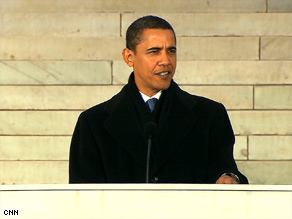
Saying that civil rights leaders from decades past paved the way for his election as the nation's first black commander in chief, President Barack Obama paid homage to the NAACP and advised members that their work remains unfinished.
Obama traced his historic rise to power to the vigor and valor of black civil rights leaders, telling the nation's oldest civil rights organization Thursday night that their sacrifice "began the journey that has led me here." He also prodded them to look beyond simply African-American rights as the group celebrated its 100th convention.
"Make no mistake: The pain of discrimination is still felt in America," the president told the friendly audience that erupted in standing applause and the occasional "Amen" during his remarks.
Rousing his audience, Obama offered his most direct speech on race since winning the White House, a mix of personal reflection and policy promotion. He had worked on the address for about two weeks and revised it until shortly before he spoke, his aides said, underscoring the importance of his message and his audience.
Implicit in his appearance was that he is seeking the backing of the powerful NAACP and its members for his ambitious domestic agenda. He also is careful not to forget a groundswell of black voters who reshaped the electoral map, although they didn't singularly deliver him to the White House.
Painting himself as the beneficiary of the National Association for the Advancement of Colored People's work, Obama cited historical figures from W.E.B. DuBois to Thurgood Marshall, Martin Luther King Jr. to Emmet Till to explain how the path to the presidency was cleared by visionaries.
Despite the racial progress exemplified by his own election, Obama said African-Americans must overcome a disproportionate share of struggles, including being more likely to suffer from many diseases and having a higher proportion of children end up in jail.
"They're very different from the barriers faced by earlier generations. They're very different from the ones faced when fire hoses and dogs were being turned on young marchers," Obama said. "But what's required to overcome today's barriers is the same as what was needed then. The same commitment. The same sense of urgency."
Obama expanded his message of equal rights beyond the black communities. He said many Americans still face discrimination and suggested the NAACP — looking to declare a mission for its second century — might embrace a broader mandate in coming years.
Obama's remarks, steeped in his personal biography as the son of a white mother from Kansas and black father from Kenya, challenged the audience — those in the room and those beyond — to take greater responsibility for their own future.
He urged parents to take a more active role, residents to pay better attention to their schools and students to aspire beyond basketball stars and rappers.
"I want them aspiring to be scientists and engineers, doctors and teachers, not just ballers and rappers," Obama said. "I want them aspiring to be a Supreme Court justice. I want them aspiring to be president of the United States."
With that line, Obama drove the hotel ballroom audience to its feet.
Throughout his comments, Obama sought a balance, contending that the government must foster equality but individuals must take charge of their own lives. It was reminiscent of earlier Obama speeches, calling on fathers to help their children and adopting a tone that at times seemed drawn from the pulpit.
"We have to say to our children, `Yes, if you're African-American, the odds of growing up amid crime and gangs are higher. Yes, if you live in a poor neighborhood, you will face challenges that somebody in a wealthy suburb does not have to face," Obama said, returning to his tough-love message familiar from his two-year presidential campaign.
"But that's not a reason to get bad grades, that's not a reason to cut class, that's not a reason to give up on your education and drop out of school. No one has written your destiny for you. Your destiny is in your hands."
Today, Obama said, it is not prejudice or discrimination that presents the greatest obstacles for blacks, but rather structural inequities_ in areas such as education and health care. Still, he said discrimination persists — and not just for blacks — and chided those who may contend otherwise.
Source
With a fireworks show and a picnic at the White House, President Barack Obama leads the nation in observing Independence Day.
Saturday is also his daughter Malia's 11th birthday. Twenty of her young friends have joined the first family at the Camp David presidential retreat in the mountains of Maryland to help celebrate.
By evening, the Obama family will be back at the White House, where the president hosts a barbecue on the South Lawn for 1,200 military families, saluting their service to the nation. It'll all be capped with Washington's traditional Fourth of July fireworks extravaganza.
The president sets off Sunday on a weeklong trip to Russia, Italy and Ghana, his first trip to sub-Saharan Africa as president.
President-elect Barack Obama speaks at inaugural concert
watch performances from the concert
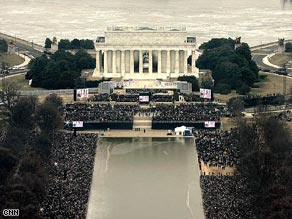
Thousands gather Sunday afternoon on the National Mall in Washington.
Inauguration revelry began Sunday afternoon as thousands of people packed the National Mall in Washington for a free concert featuring big stars.
President-elect Barack Obama addressed a roaring crowd after 90 minutes of high-energy acts such as U2, Mary J. Blige, Usher and Beyonce.
"Welcome to this celebration of American renewal," he said.
"In the course of our history, only a handful of generations have been asked to confront challenges as serious as the ones we face right now."
"I stand here today as hopeful as ever that the United States of America will endure," Obama said. "That it will prevail; that the dream of our founders will live on in our time."
Obama spent the morning visiting Arlington National Cemetery and attending church before heading to the "We are One: Opening Inaugural Celebration" at the Lincoln Memorial. It was nothing but good vibes -- a brief respite for an incoming president who will face huge problems after he takes office Tuesday.
Bruce Springsteen opened the concert with his song "The Rising," singing, "How far I've gone/How high I've climbed/On my back's a 60 pound stone/On my shoulder a half mile line."
Along the National Mall, between the Capitol and the Washington Monument, people watched the concert on massive screens and sang along with "America the Beautiful" and "This Land is Your Land."
During U2's performance of "Pride (In the Name of Love)," a tribute to the Rev. Martin Luther King Jr., frontman Bono referenced the civil rights leader's "I Have a Dream" speech, saying that it was also, "an Irish dream, a European dream, and African dream, an Israeli dream, and a Palestinian dream." read more