President Barack Obama's stimulus bill was passed fewer than five months ago. Only a small fraction of the money has been spent, but Republicans already know it's a failure.
"The trillion-dollar stimulus passed in February has not produced the jobs that were promised," Florida Rep. Vern Buchanan said in a news release.
"I am convinced that it won't work," California Rep. Darrell Issa said on Capitol Hill.
"A second stimulus is an even worse idea than the first stimulus, which has been demonstrably proven to have failed," Senate Minority Leader Mitch McConnell told reporters.
Republicans, of all people, are supposed to know instant gratification isn't always possible. Be patient, guys. Save yourselves for marriage.
More puzzling are similar sounds from Democrats, who in talking about a second stimulus package seem as if they're writing off the one they already passed like a Citigroup subprime mortgage.
"We need to be open to whether or not we need additional action," House Majority Leader Steny Hoyer said on Capitol Hill.
The country "should be planning on a contingency basis for a second round of stimulus," Obama economic adviser Laura Tyson told a conference in Singapore.
Don't pay much attention. Republicans just want to rile the base by damning helpful measures passed by their opponents.
Democrats are setting up excuses for next year's elections, when no matter what happens, the economy won't be making us all rich. It's not our fault, they'll say. The Republicans blocked a new stimulus.
But give the old stimulus a chance.
People keep grumping to me about Obama's "socialism" and then, in practically the same sentence, criticizing the paltry extra in their paycheck that the stimulus made possible.
"Thirty dollars a month. What a joke," they'll say, conjuring the old story of the Catskills resort customer who complains about the terrible food as well as the small portions.
Presumably for, say, $500 a month, socialism would be OK.
Nothing government does to the economy happens immediately.
When the Federal Reserve cuts or raises interest rates, it takes about 18 months to make a difference, economists estimate. Tax cuts or tax increases aren't fully felt for years.
The Obama stimulus isn't even out the door.
Only about $100 billion of the $787 billion package has been spent. As pointed out in yesterday's Wall Street Journal by Edward Lazear, who was head of the Council of Economic Advisers under President George W. Bush, much of that money was transferred to state agencies, which are still sitting on it.
But it will all get spent, much of it this year. It'll finance highway construction and fixing water systems and improving homes for soldiers. It'll weatherize government buildings, saving taxpayers on energy costs. It'll improve telecom connections, flood control, the electricity grid and the computers at the Social Security Administration in Woodlawn.
All this will create jobs. Most of the package is direct spending, approved on the not unreasonable notion that it will prompt hiring and buying whereas a tax cut of equal size would likely have been stashed in the bank. But Republicans conveniently forget that the deal includes $288 billion in individual and corporate tax cuts.
The fiscal stimulus is only part of the government's response. Other injections haven't been fully deployed, either. The Federal Reserve's and Treasury Department's Public-Private Investment Program, which has the potential to take billions in dubious mortgage assets off Wall Street books, hasn't spent a dime yet. The government isn't anywhere near done issuing credit to grease consumer lending or helping marginally troubled homeowners stay in their houses.
Did the Democrats tell a whopper about how bad the economy might get or how much the stimulus would help? Yes. It's very reminiscent of the fabulous job growth that Bush said would result from his 2003 tax cuts. Didn't happen.
Last week's miserable employment report was the main cause of the stimulus failure talk. The nation shed 467,000 jobs in June, according to preliminary estimates, far more than economists predicted. Unemployment rose to 9.5 percent.
Even so, job losses were worse in every other month this year but one. New claims for unemployment benefits peaked months ago. Factory orders for May rose the third time in four months. Consumer confidence has been rising.
The worst economy in 80 years won't heal in a few months. Republicans need to stop complaining about the medicine when most of it hasn't even been swallowed.
And Democrats ought to stop mixing up another dose. (Senate Majority Leader Harry Reid gets it: "There's no showing to me that a second stimulus is needed," he said, according to USA Today.) They've got enough work to do dispensing the one they already prescribed.
Source
World leaders: We can unite to defeat economic crisis
Leaders attending the G-20 summit in London Thursday said they were confident they could bridge their differences to unite on a plan to help address the economic crisis.
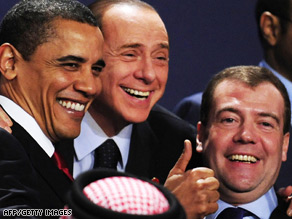
Barack Obama, Silvio Berlusconi and Dmitry Medvedev share a laugh at the G-20 summit.
There had been concerns that a rift was opening up between the approach being championed by the U.S. and Britain and that favored by France and Germany.
The U.S. and Britain want countries to agree to more economic stimulus ahead of new rules for the banking system.
France and Germany want the rules first -- and tougher ones than initially suggested -- and remain resistant to pumping more money into their economies.
However, European Commission President Jose Manuel Barroso said he was confident about the result of the summit.
"There is a great degree of convergence," he told CNN Thursday morning.
British Business Secretary Peter Mandelson was less upbeat, telling CNN there were some "strains" among the delegates.
"I hope very much that they will be ironed out and we'll come out with agreement at the end of the day." Video Watch more on the G-20 summit »
The leaders say they want to find ways to stabilize financial markets throughout the world and pull the world out of a deepening recession.
They sat at the table Thursday for their first session with several targets in their sights, including tax havens and protectionism.
French Finance Minister Christine Lagarde called for a firm stand on tax havens.
Fact Box
This week's London Summit brings together the leaders of the world's 20 largest economic powers, known as the Group of 20, to discuss the global financial crisis and decide new measures to set the world on a more stable economic footing.
Barroso backed her up.
"We have to be clear that those that want to keep shadow banking systems that are kind of underground (with) clandestine finances have to suffer sanctions, because it's once again a problem of confidence," Barroso said.
"We are for open economies and open markets, but open economies and open markets have to respect some rules." Video Watch European Commission chief on summit »
Britain will push for the same regulation of banks and financial institutions that operate in a "shadow banking world," Mandelson said. He said an international body should oversee the regulation.
Leaders will also be pushing for more fiscal stimulus.
British Prime Minister Gordon Brown is arguing for world leaders to maintain their investments and fiscal stimuli while also giving more money to institutions like the International Monetary Fund, Mandelson said.
The IMF can then deliver those resources to poorer countries and emerging economies, he said. Video Watch more on the protests »
"They are becoming major drivers of growth in the global economy," Mandelson said of those countries. "So we want a strong commitment, a hefty infusion of resources." Video Watch more on the first wives' club »
Brown wants success on five points: restoring growth to emerging market economies; a "clean up" of the global banking system; commitment to encourage growth and help the poor; protectionism rejected and a push for investment in the environment.
Barroso and Mandelson called for concrete commitments on the economy.
Earlier this week French President Nicolas Sarkozy said that if the summit's final communique failed to contain strong language and clear steps, he may even walk out of the meeting.
He and German Chancellor Angela Merkel said Wednesday they could accept debate and negotiation as long as firm steps were taken.
advertisement
There were only a few protesters outside the summit when it started Thursday -- a marked difference from the thousands who gathered in central London 24 hours earlier.
Obama Aims to Address Worries About Widening Deficit
President Barack Obama sought to assure the nation Monday that he will address runaway government deficits, despite adding to the red ink now to battle the economic crisis.
After a four-hour "fiscal responsibility summit" with both Republican and Democratic lawmakers, Mr. Obama said he was paying attention to fiscal matters large and small. He also announced a summit on health care next week at the White House, to follow the unveiling of a budget Thursday that will make room for his proposal to offer Americans near-universal health care.
"We're not going to be able to fall back into the same old habits," Mr. Obama said. "The casual dishonesty of hiding irresponsible spending with clever accounting tricks, the costly overruns, the fraud and abuse, the endless excuses."
As Mr. Obama pours money into the economy in hopes of turning it around, he is also faced with making tough decisions on stemming the tide of red ink without strangling a future recovery. He told the nation's governors Monday that the federal government will have dispensed $15 billion by Wednesday to begin shoring up the states' strained Medicaid accounts. In a speech before a joint session of Congress Tuesday night, Mr. Obama will propose some specific spending cuts, as well as the additional spending he wants on energy, education and health care, White House spokesman Robert Gibbs said.
Some participants in Monday's summit concluded that the president will attempt to address the financial soundness of the Social Security system before moving on to other, more complicated problems, such as health-care costs. read more
President Barack Obama listened to a question at a town hall meeting in Elkhart, Ind., on Monday.
President Obama took his case for an $800 billion economic recovery package to one of the most distressed places in America on Monday as he opened a series of campaign-style events intended to press Congress to approve the plan by week’s end.
Wrapping himself in the mandate of his election last November, Mr. Obama sounded like a candidate all over again, scolding greedy Wall Street bankers and pointedly rejecting Republican critics for sticking with what he called a failed philosophy. At one point, he spoke about people with as many as five homes, which sounded like a reference to his opponent last fall, Senator John McCain.
“We can’t wait and see and hope for the best,” Mr. Obama told a packed high school gymnasium that sounded like an election rally. “We can’t posture and bicker and resort to the same failed ideas that got us into this mess in the first place. That was what this election was all about. The American people rejected those ideas because they hadn’t worked. You didn’t send us to Washington because you were hoping for more of the same. You sent us there to change things.”
Mr. Obama used the event to hammer home what he called the benefits of his program of spending and tax breaks, promising that it would create or save nearly 80,000 jobs in Indiana, give 2.5 million state residents a $500 tax credit and provide health care, unemployment benefits and job training for tens of thousands more. Bringing it down to the most local level, he suggested his plan would help rebuild U.S. Highway 31 and build an overpass in Elkhart. read more


President Barack Obama says he will be held accountable for turning around the nation's ailing economy, and making sure that federal funds used to rescue financial institutions and spur growth are well spent.
Less than two weeks in office, President Obama inherited a deepening recession that began more than a year ago. But if blame for the current economic pain and dislocation cannot be pinned on him, the president says he is fully aware that responsibility for reviving the economy falls on his shoulders.
Mr. Obama spoke in a pre-recorded interview that aired on the NBC television network.
"I will be held accountable. I have got four years [first term in office]," the president said. "I think a year from now people are going to see that we are starting to make some progress, but there is still going to be some pain out there. If I do not have this [economic recovery] done in three years, then there is going to be a one-term proposition [will not be re-elected]."
The president is pushing an $800 billion package of tax cuts and new government spending to stimulate an economy that contracted at a 3.8 percent annual rate in the final three months of 2008. The bill is before the U.S. Senate, after being approved by the House of Representatives on a party-line vote last week.
Republicans blast stimulus package
Republicans have blasted the measure, saying it is laden with wasteful spending that will increase the deficit without spurring growth. Democrats say the bill will boost the economy immediately and make investments in energy and infrastructure that will promote long-term economic expansion.
Mr. Obama says U.S. banks and other financial institutions continue to be at risk of failure, despite receiving hundreds of billions of dollars in federal bailout money in recent months. The president says additional funds will be required to prop up those institutions, as well as regulations to ensure the money is not wasted and there is no repeat of the debacle. read more
Yes He Can, and He’ll Tell You About It
Spend time with President-elect Barack Obama, and you won’t question the confidence he will carry into the Oval Office eight days from now. He doesn’t.
Interview: Obama on the Economy
John Harwood of The New York Times and CNBC sits down with President-elect Barack Obama.
At 47, Mr. Obama is inheriting an economy that has shed one million jobs just in the two months since his election. He has held public office barely longer than his eldest daughter, 10-year-old Malia, has been alive.
Yet he brims with self-assurance about himself, his program and his ability to rally a fearful American public. For evidence that his internal buoyancy resonates with the American public, consider that 82 percent of people polled by CNN last month credited Mr. Obama with the ability to inspire confidence.
The desk behind Mr. Obama at transition headquarters holds bound volumes of the words of one president: John F. Kennedy. He doesn’t shrink from comparison with Kennedy, another charismatic 40-something president with an attractive young family and a Harvard pedigree.
“You’ve got to watch those Harvard guys, they’ll get you every time,” Mr. Obama said with a chuckle during a recent interview. He vowed to avoid the stumbles of Kennedy’s “Best and the Brightest” by seeking a broad range of advice.
And he shrugged off concerns about overconfidence by invoking his skills: “What I do have confidence about is that I’m a good listener, I’m good at synthesizing advice from a range of different perspectives, and that we will make the best possible decisions from the perspective of what’s good for ordinary Americans.”
Embracing Roosevelt
The leadership challenge he faces most often draw comparisons with Franklin D. Roosevelt during the Great Depression. He embraces that, too.
“If you look at F.D.R.’s first speech, the line that’s remembered is ‘The only thing we have to fear is fear itself,’ ” Mr. Obama said. “But actually the bulk of the speech centered around the need to act and act now.
“This is a bit of advice that I received from one of the former presidents,” he continued. “He said, ‘Part of the reason, Barack, that you’re doing well right now is because you don’t talk down to the American people, you play it straight and just explain what it is that’s taking place.’ read more


